
Beyond the Deck
#22: Don't Be Invisible: Why Silence and 'False Humility' Are Sabotaging Taiwan's Local Talent
A 12-point explanation meant to show diligence in Taiwan can strike Western leaders as an inefficient use of their time.
Taiwan’s corporate landscape is becoming increasingly international. Government data shows that registrations of foreign-based firms rose significantly in 2024, reaching 7,051—a 26% on-year increase that underscores a robust appetite for the island’s tech-heavy industrial base.
This interest translates to a surge in demand for local talent. As tech giants like Google, Amazon, Microsoft, Apple, and Nvidia shift toward local hiring amidst economic and geopolitical uncertainty, more Taiwanese workers are reporting directly to Western leadership. In this environment, mastering cross-cultural communication is no longer optional; it is a career necessity.
What is Cross-Cultural Communication?
Cross-cultural communication is the proactive process of identifying cultural intersections to bridge diverse perspectives. It is less about mere awareness and more about strategically adapting one’s style to ensure clarity. As Dr. Patty Goodman of Northeastern University explains, this fluency is essential for resolving conflicts and building the networks necessary for a thriving work environment. It is not a zero-sum game of who is “right,” but an intentional effort to respect different professional habits.
Five Common Cultural Traps for Taiwanese Employees
1. Respect for Hierarchy vs. Critical Thinking
In the Confucian tradition practiced in Taiwan, hierarchy is strictly observed, and employees are often viewed as “executors.” While this makes Taiwanese employees excellent doers, many Western bosses may feel they are paying you for more than just following instructions; they are paying you for your ideas and ability to think critically. They welcome contrarian views and embrace different opinions. In the “flat” structures often seen in Silicon Valley, those who offer a unique perspective or challenge the authority are often rewarded with more attention and better compensation.
2. The Meeting Divide: Monologue vs. Dialogue
The “All-Hands” or “Ask Me Anything” (AMA) meeting is the ultimate litmus test for this gap. In many Taiwanese companies, these meetings are monologues; the leader speaks while employees remain quiet. In contrast, a Silicon Valley All-Hands is a lively, back-and-forth conversation. These sessions can even become heated as employees push for transparency.
This stems from “psychological safety”—the belief that you won’t be punished for speaking up. In a Western MNC, silence is often misread as indifference or a lack of confidence. By staying quiet, you allow others to define your value. Leaders award “brownie points” to those who care enough about the mission to ask tough questions.
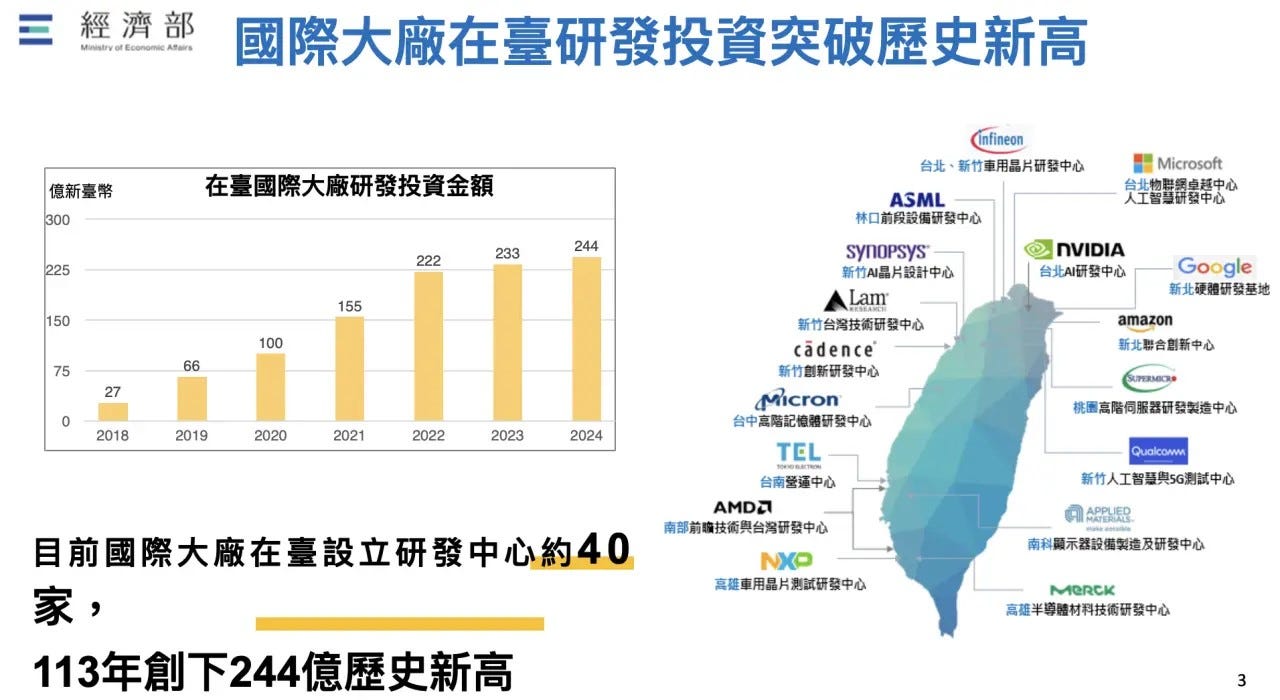
Taiwan’s MOEA 2025 data shows foreign R&D investment reached a historic NT$24.4 billion in 2024, with 40 international firms now operating R&D centers locally.
3. The “Over-Explain” Trap
Albert Einstein famously said, “If you can’t explain it to a six-year-old, you don’t understand it yourself.” Foreign leaders often complain that Taiwan employees present long-winded decks packed with data rather than distilling a presentation into three key points. While a Taiwanese employee may think a 12-point explanation shows thoroughness, a Western leader may see it as an insensitive use of their time. Leading with the conclusion is vital for global visibility.
4. The Peril of False Humility
In local culture, downplaying achievements shows modesty. However, in a Western firm, if you don’t clearly state your contribution, your manager may not know you were responsible. If you hide your light, you aren’t being humble—you are being invisible.
This is best illustrated by my nephew, who recently beat out a large pool of applicants for a competitive role. He later asked his boss why he was chosen. The answer: “Of everyone who interviewed, you were the only one who dared to pull a chair up to my desk and sit down. Everyone else stood because I didn’t explicitly offer a seat. That showed me you are confident—and I need confident salespeople.” In an MNC, your boss is looking for that “seat at the table” energy.
5. Data Storytelling: Control the Narrative
Taiwanese employees are sometimes too timid to draw their own conclusions, fearing that an incorrect analysis might lead to a loss of “face.” Consequently, many present raw numbers without context. For a busy global head, this is dangerous.
When you provide data without a narrative, you lose control of the interpretation. Leaders removed from daily local operations lack the nuance to understand what the numbers signify. To gain trust, you must connect the dots for them so you can appear to be the expert of this subject. Don’t just say a “20% jump”; explain that this increase secures a lead against a competitor or accelerates an IPO goal. By offering an interpretation, you move from being a reporter to a strategic advisor.
Conclusion: Bridging the Gap
Technical excellence is no longer enough to get ahead. To bridge the gap between local execution and global leadership, Taiwanese professionals must evolve into active, confident communicators and storytellers. Success requires you to drive your narrative and ensure your value is not just delivered, but understood.
Call to Action
At your next meeting or review, challenge your default mode:
Speak up: Ask one well-reasoned question, followed by another follow-up.
Claim your space: State your contribution correctly.
Contextualize: Offer your analysis of what the numbers mean for the company’s future.
Your career growth depends on your ability to be seen. Don’t just do the work—make sure the company knows why it matters.
About the author: Jenny is the co-founder and head creator of Day 2 Coaching.
← Back to all posts